


New research from the Institute for Private Capital (IPC) examines what drives pricing in the private equity secondary market and whether the growing influence of evergreen funds is pushing prices higher.
The study, conducted by Gregory Brown and William Volckmann, draws on proprietary SecondaryLink and EvergreenLink data covering 2,983 pricing observations for buyout funds between September 2015 and December 2025. The sample combines secondary bids and completed transaction prices with 783 purchases by evergreen funds.
The findings suggest that secondary prices continue to reflect historical market patterns despite record transaction volumes, with no conclusive evidence that evergreen buyers are inflating valuations. The research also identifies differences between the factors influencing which funds trade and the prices they command.
Below is a summary of the white paper's key findings.
Secondary Pricing Trends
Across the dataset, buyout fund interests were priced at an average of 91.8% of NAV, representing an 8.2% discount, with a standard deviation of 14 percentage points. North American fund interests traded at steeper discounts, averaging 89.5% of NAV, versus 94.2% in Western Europe.
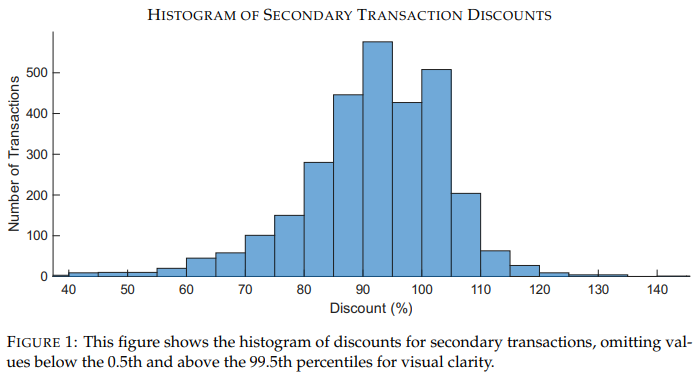
The study also found that larger and middle-aged buyout funds were more likely to transact, with funds in the sample averaging $4.8 billion in size and approximately seven years in age. Funds from stronger-performing vintages, meanwhile, were less likely to trade.
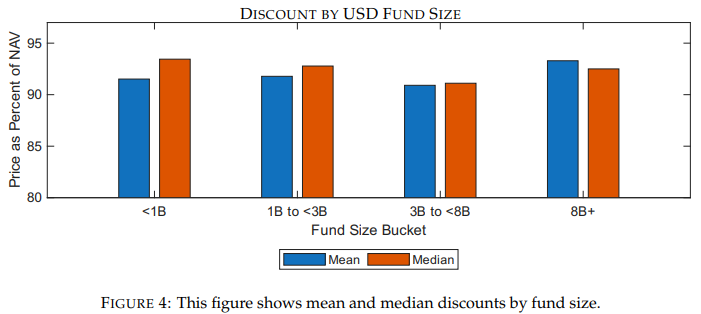
While fund size and age influenced both transaction activity and pricing, the factors determining whether a fund trades differed from those affecting the price it commands. Larger vehicles generally fetched higher prices relative to NAV, but observable fund and market characteristics explained only 24% of pricing variation in the researchers' main model.
The findings suggest that other factors, including negotiating power and transaction-specific circumstances, may play a substantial role in determining secondary prices.
NAV as a Measure of Value
Consistent with existing literature, the study found that secondary prices closely tracked public equity market returns, with discounts generally widening during periods of market stress and narrowing as conditions improved.
This relationship also highlights the limitations of reported NAVs as a measure of private equity value. Because fund valuations typically adjust more slowly than public markets, secondary prices can reflect changing conditions before those adjustments appear in GP-reported NAVs.
Drawing on earlier academic findings, the authors argue that NAV should not be treated as "a reasonable floor for negotiating secondary pricing," as reported valuations tend to smooth fluctuations in underlying asset values.
Instead, secondary discounts reflect a combination of liquidity costs, market conditions, and differences between reported valuations and buyers' assessments of underlying assets, rather than necessarily indicating mispricing.
The Rise of Evergreen Funds
Evergreen buyers accounted for 783 observations, more than a quarter of the dataset, with their participation increasing substantially in recent years.
Despite this growth, the researchers found no reliable evidence that evergreen buyers systematically drove secondary prices higher.
One statistical model suggested that transactions involving evergreen buyers were priced approximately 5.7 percentage points below those involving other buyers, after accounting for observable fund and market characteristics. However, the authors cautioned that differences in pricing dynamics, the concentration of evergreen transactions in recent years, and limitations in the model reduced the reliability of this estimate.
A separate time-series analysis found that aggregate secondary prices between 2023 and 2025 averaged 1.9 points above levels predicted by historical market fundamentals, coinciding with a period of rapid evergreen growth.
While this statistically significant difference suggests modest upward pricing pressure, the researchers could not establish whether evergreen participation was responsible.
The authors therefore concluded that the evidence remains mixed, with no conclusive indication that the expansion of evergreen capital has inflated secondary-market valuations.
Secondary Market Outlook
The study concludes that recent secondary market activity remains broadly consistent with historical pricing patterns, despite record transaction volumes and a prolonged slowdown in private equity distributions.
Market-wide secondary pricing averaged approximately 83% of NAV in 2025, with buyout interests pricing closer to 86%, according to industry figures cited in the paper. SecondaryLink Data shows that the average SecLink Market Price stood at ~85% across all fund strategies and ~87% for buyout funds in October.
The authors point to a well-capitalized market adjusting to changing public market valuations rather than widespread distress or speculative excess.
They also suggest that record transaction volumes reflect structural demand for liquidity as the industry's unrealized asset base expands, rather than necessarily signaling an unsustainable market peak.
The longer-term question is whether the rapid growth of evergreen and other perpetual vehicles will fundamentally change secondary market pricing dynamics. With the evidence still inconclusive and based on a limited sample, the authors call for future research on the growing role of evergreen buyers and their potential influence on secondary market pricing.

The unsolicited bid comes just three days after Blue Owl Credit Income Corp. disclosed 16.8% in Q3 redemption requests.

"The Cox Capital Offer appears designed to transfer value from BCRED shareholders to Cox Capital and its investors," according to a Board recommendation viewed in EvergreenLink's Notice Board.

The combined $25 million program prices ADS and ASIF shares at 14.6% and 13.4% discounts to August NAVs respectively, after both funds again capped repurchases.

Cox Capital Retail Secondaries Fund I is seeking up to $40 million of BCRED and HLEND at discounts to NAV of 12.5% and 17.5%, respectively.

The LP interests were reportedly priced at a discount of more than 10% and included software and other tech-focused buyout funds.

Cox Capital currently has outstanding cash offers for five private debt vehicles, with discounts to NAV ranging from 14% to 37%.

The Philadelphia-based investment manager has expanded its recurring liquidity program to now include five non-traded BDCs.

At least 80% of net proceeds from the transaction will be directed toward a share buyback program aimed at generating liquidity and NAV accretion.

CF Private Equity explores the main factors that shape pricing in the LP-led secondaries market, from asset quality and portfolio composition, to process dynamics and buyer demand.


