


The secondaries market has spent the last few years absorbing a structural liquidity squeeze. Distributions slowed, exit windows narrowed, and some investors found themselves slightly over-allocated to private markets with fewer natural avenues to recycle capital. The result has been a boom in secondary activity as LPs turn to the market to manufacture the liquidity that primary exits have not delivered.
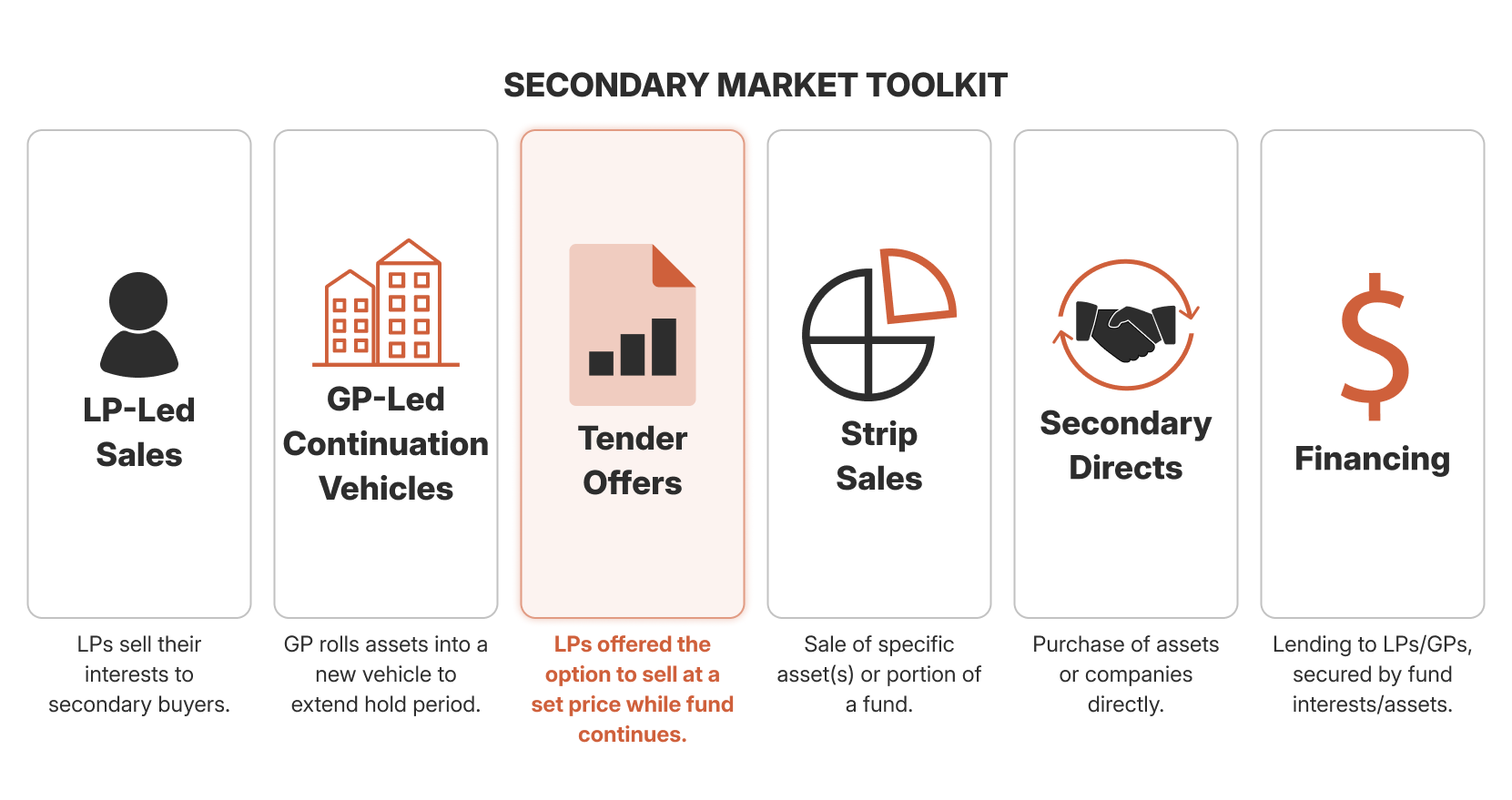
That demand has broadened the toolkit. Buyers today see LP-led sales, GP-led continuation vehicles, tender offers, strip sales and NAV financings crossing their desks, sometimes even on the same assets. Each is a liquidity instrument with its own trade-offs in speed, cost, control, complexity, and not to mention certainty. And among them, the tender offer has quietly been on the rise and become one of the most useful.
Why a tender?
Tenders can run as an alternative to a GP-led transaction since they are a way to give LPs liquidity whilst the GP remains in control of the assets. They are, in most cases, easier, faster and cheaper to execute than a GP-led transaction. A continuation vehicle is a full transaction in its own right, with a new fund to raise, a new vehicle to stand up, assets to transfer and a price to be validated (sometimes across a syndicate). A tender, by contrast, offers a defined pool of LPs the option to sell at a set price while the existing fund carries on largely untouched.
That last point is often the real driver. A GP may have every reason to keep a fund running longer — to see a thesis through, to avoid a forced sale at the wrong point in the cycle — while still wanting to give some investors a way out. Tenders square that circle. They are also a natural companion to a new fundraise: offering existing LPs liquidity can smooth the path to fresh commitments in the successor vehicle.
The documents that matter
Two instruments frame the deal. The tender offer document sets out the offer and its terms, the timetable, and precisely what a seller must do to participate. The purchase and sale (or transfer) documentation looks much like a conventional LP secondary, but with certain features specific to a tender — particularly around conditions to closing and the allocation of liability for the process itself. Getting this right is key to the buyer.
What buyers should be deciding
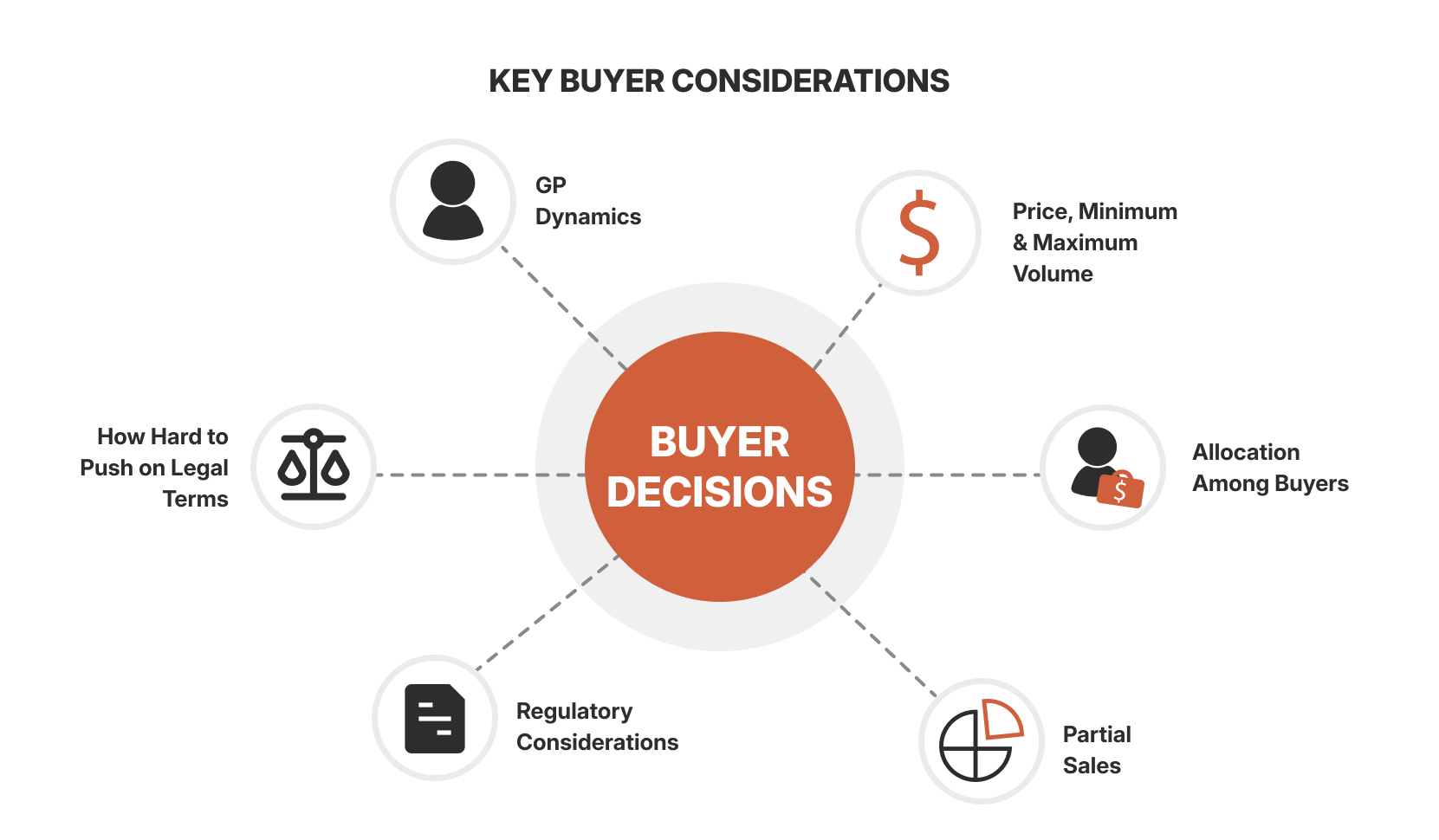
The commercial architecture of a tender is set almost entirely by the buyer in conjunction with the GP, and a handful of decisions do most of the work.
GP dynamics. A successful LP tender requires the GP to support the process. GPs are often viewing LP tenders as a way of giving LPs the option of taking cash off the table (and even sometimes help to secure a staple commitment to their newest offering). There are sometimes also LPA changes that are implemented in connection with a tender, e.g. to extend the term of a fund. The buyer / incoming LP may also want to negotiate side letter rights given that they will often become one of the largest, if not the largest LP in the fund.
Price, minimum and maximum volume. Price is the obvious lever, and buyers must seek to strike a balance between getting a low price vs. getting sufficient sell-side volume. Also, the boundaries in terms of volume need to be considered. Most buyers will cap the maximum purchase — limiting total consideration to a defined size — and set a minimum to ensure the deal clears at a scale that justifies the effort. Both belong in the offer from the outset.
Allocation among buyers. Where several buyers participate, and seller volume falls short of appetite, the allocation waterfall matters. The common structure gives the lead buyer priority up to an agreed amount, after which participants share the remaining volume pro rata. Agreeing this before launch avoids friction later.
Partial sales. Buyers must take a view on seller optionality: full interest only, or partial sales permitted. Many prefer to offer sellers a fixed menu — say, 100% or 50% — which simplifies the decision for the seller and keeps the transfer mechanics clean.
Cost coverage. Fund and GP costs are typically split 50/50 between sellers (pro rata) and buyers (pro rata). Lead buyers can often negotiate coverage of their own transaction expenses on the same basis — a point worth raising early.
How hard to push on legal terms. The form PSA is presented as part of the offer, and sellers are expected to sign it without negotiation. That structural advantage cuts both ways: an aggressive, off-market PSA depresses participation. The buyers who secure the highest uptake are usually those who keep the terms balanced and recognizably in line with market practice.
Process is not an afterthought
Tenders are coordination-heavy. Someone has to communicate with a fragmented seller base, field questions, collect elections and manage payment. In most cases, the GP takes this role, often also acting as payment agent and handling withholding tax matters, although typically makes no recommendation on the investment advice either to buy or sell; they sometimes specifically state that they are neutral on the transaction and only put forward the 'approved buyer' LP terms. Agreeing who owns each of these functions — and how sellers will be reached — is important to run a smooth process.
The US tender offer overlay
Depending on the jurisdictions of the fund, the sellers and the interests involved, regulatory analysis is essential — and an important? question is whether the offer must be structured to comply with the US tender offer rules. Where it does, Regulation 14E's anti-fraud and procedural requirements apply to the offer regardless of whether or not the interests are registered. That means that certain requirements need to be kept in mind, importantly treating sellers equally, keeping the offer open for at least 20 business days, extending it by at least 10 business days following any change in price or the amount sought, and paying for or returning tendered interests promptly on expiration. These are not mechanical footnotes; they shape the timetable and the economics, and they are best mapped at the structuring stage rather than discovered mid-process.
For buyers, the takeaway is straightforward. The tender is a precise instrument, not a blunt one. Handled well — with disciplined volume limits, a clear allocation logic, a balanced PSA and a process everyone has agreed in advance — it delivers liquidity faster and more cheaply than the alternatives, and it does so on terms the buyer largely sets.
About DMX
DMX Partners is a law firm specializing in indirect investments in private markets, with a mission to partner with clients to deliver seamless, efficient transactions. The firm takes a fresh, client-centric approach to legal transactional support; its team is composed of lawyers, tax counsel, and dedicated transaction closers, and the role it takes also includes tasks typically handled by internal counsel. DMX closes 100+ transactions per year across single-line and portfolio LP transactions as well as GP-led deals, working with a diverse global base of buyers and sellers including dedicated secondaries funds, institutional asset managers and family offices. Learn more at dmxpartners.com.

Kirkland reviews the implications of ILPA's updated CV guidance on transaction processes, investor protections, and sponsor economics.

"Our clients have told us that they need market leading secondaries capability. We listened," said UK Managing Partner Denise Gibson.

The former Freshfields Global Co-Head of Private Funds and Secondaries will advise on secondary transactions and related liquidity solutions, including CVs, LP portfolio sales, and recapitalizations.

Maples Group examines how GP entity choices shape borrowing capacity, security structures, lender diligence, and overall fund finance execution across Cayman Islands fund formation.

Troutman Pepper examines the key legal and structural considerations lenders should assess in private credit continuation fund transactions.

The former Reed Smith fund finance counsel advises on a full range of products, including subscription, NAV, GP, co-invest, management line, and continuation vehicle financings.

Mayer Brown examines the evolving legal and governance framework for continuation vehicles as regulatory uncertainty, ILPA guidance, and litigation reshape GP-led transactions.

Haynes Boone analyzes the key underwriting, collateral, and due diligence considerations shaping fund finance for continuation vehicle transactions.

This Humphreys Law article discusses PE secondaries as a mainstream asset class, spanning LP and GP-led deals, transfer agreements, valuations, conflicts, and regulatory scrutiny.


