



Blue Owl has established itself as a key capital provider in the private markets, with over $250 billion in AUM and 200+ partnerships, earning a reputation for helping private equity firms scale and optimize liquidity.
The firm is best known within the secondary market for its GP stakes business, where it provides permanent capital to private equity firms in exchange for minority ownership interests. In addition to GP stakes, Blue Owl has built a significant private credit platform, offering direct lending, NAV-based financing, and other structured credit solutions to both private equity firms and their portfolio companies.
Acknowledging the growing demand for liquidity solutions in private markets, Blue Owl entered the GP-led secondaries space in April 2023, launching its Strategic Equity strategy focused predominantly on single-asset continuation funds and other minority private equity investments. Leading this effort is Chris Crampton, Senior Managing Director and Head of Blue Owl Strategic Equity.
Recognized for its impact across private markets, the firm was awarded Top GP Stakes Buyer and Top New Entrant in the 2024 SecLink Awards. In this exclusive interview, SecondaryLink speaks with Crampton to discuss the progress of its secondaries strategy, the evolution of GP-led deals, and the firm's growing role in shaping the private markets landscape.
The Shift to GP-Led Secondaries
With over two decades in private markets, Crampton brings a deep understanding of alternative investments. Before joining Blue Owl, he was a Partner at Goldman Sachs, where he led services and industrials private equity investing within the Merchant Banking and Asset Management Divisions.
Crampton's move to Blue Owl and GP-led secondaries was driven by a confluence of factors-most notably the CV transaction activity that Blue Owl had already begun to see in the market.
"The firm had already completed seven continuation fund investments before I joined," he explains. "Institutionally we hadn't been actively seeking to invest in these transactions-deals were coming to us organically through the unique GP relationships we have via our GP stakes and private credit businesses."
During his time at Goldman Sachs, Crampton saw firsthand how GP-led secondaries were emerging as a nascent but rapidly growing asset class. "You could see in 2022 that the CV market was about to take off as the benefits of CVs were becoming increasingly appreciated and understood by all major participants in the PE ecosystem - GPs, LPs, CV investors, and management teams alike - but the backdrop of a more challenged exit environment for PE at that time really served to catalyze and accelerate growth in the asset class."
Applying a Direct Private Equity Lens to Secondaries
Coming from a private equity background, Crampton emphasizes the importance of bottoms-up company diligence in GP-led investing.
"While underwriting the sponsor and deal partner is critical, the core skill of investing in single asset GP-leds has, in our view, many characteristics similar to direct PE-namely, a bottom-up approach to evaluating the company," he says. "That means deep diligence into financials, management teams, sector outlooks and secular trends, value creation levers, exit strategies, and of course valuation."
Despite the similarities, he acknowledges the difficulties of often having less information relative to private equity processes to make informed investment decisions. "One of the challenges of the approach is that often information and access are not as comprehensive or extensive relative to a direct PE process, though that is starting to change. As a result, we are typically working behind the scenes leveraging the broader Blue Owl platform and working with other participants in the PE sector to derive unique insights into an industry or company."
Crampton continues, "Many CV investment opportunities are in sectors where Blue Owl has a long track record and deep experience of investing in already. We'll also often work with multiple third parties like consulting, accounting, management reference firms, or investment banks on the buyside. We'll typically leverage Blue Owl relationships to speak with several PE firms or operators that have owned or operated similar assets in the sector, and in many cases, we'll dialogue directly with the GP that previously owned that same CV asset."
Crampton also sees key differences in their nascency and undercapitalization. "The number of sponsors new to continuation funds still surprises me-and even among PE firms that have executed a CV previously, partner fluency in the asset class within that institution can vary dramatically." In 2024, nearly two-thirds of these deals were led by sponsors executing a continuation fund transaction for the first time, highlighting the market's growth potential.
GP-Leds vs. LP-led Secondaries
While GP-led transactions fall within the secondary market, Crampton believes that the asset class is increasingly being viewed by investors as an alternative to direct private equity rather than an adjunct to the LP-led secondary market.
"Relative to LP-leds, CV deals are obviously more concentrated, requiring deeper diligence on the asset, but they also come with higher return potential," he says. As a result, "given those key differences, in our view, we think that the LP-led and single asset GP-led markets will slowly diverge over time - with multi-asset CVs split somewhere along the middle depending on the number of assets in the deal."
Comparing the asset class to direct private equity, Crampton cites some of the recent work done by Evercore and Morgan Stanley, suggesting that CVs offer more consistent returns and advantaged capital preservation relative to direct PE. "It intuitively makes sense-by investing in already highly performing companies well known to the sponsor already and where the GP is doubling down economically on that asset, as an investor you've eliminated the blind pool risk relative to private equity where sponsors are nearly always acquiring companies for the very first time and don't have the same incumbent familiarity with the company, management team or sector."
Another advantage? Faster capital return. "While I think the ability to better mitigate the J-curve is relatively well known and appreciated, CV investments also benefit from typically faster repayment relative to direct PE. Single asset CVs have, on average, a four-year investment tenor- shorter than the traditional five-year plus PE investment cycle," he adds.
Despite growing demand, GP-leds remain significantly undercapitalized. "The direct PE market has seven times more dry powder than transaction volume, while secondaries operate at about 2x. For GP-led secondary investing, that capital imbalance is even wider."
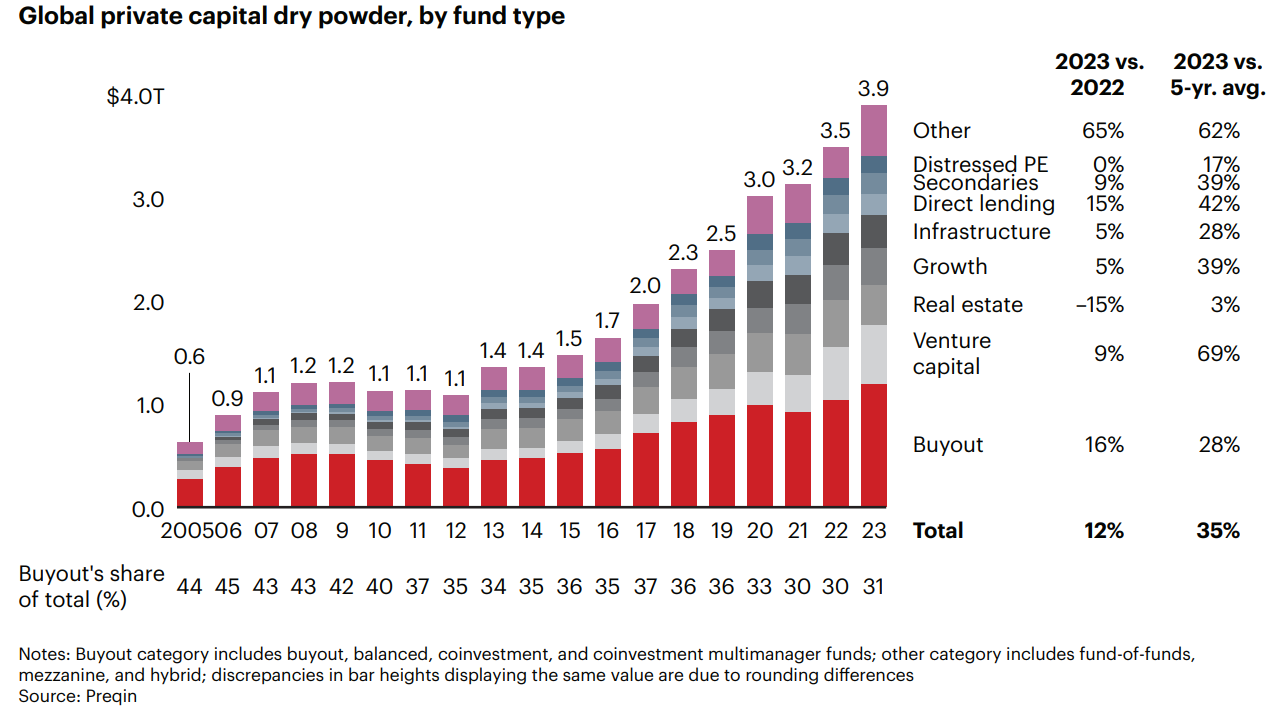
According to Bain's 2024 Global Private Equity Report, the PE industry is sitting on an unprecedented $3.9 trillion in unspent capital, the largest share of it ($1.2 trillion) in buyout funds. While other strategies draw concerns for having too much dry powder, the secondaries space is undercapitalized. Currently, the asset class has about $200 billion of dry powder, or enough to fund only about 20 months' worth of transaction volume.
Building a GP-Led Business and Scaling at Blue Owl
Launching a new business within a large organization brings both challenges and advantages. For Crampton, the biggest hurdle was building the right team.
"I spent a lot of time bringing in people with diverse investing backgrounds-from direct PE and secondaries and by sector-and who fit both within our team and Blue Owl's unique entrepreneurial culture," he shares. "When I first started talking to the firm about this idea, Blue Owl had less than $100 billion of AUM and about 500 employees. Two years later it's over $260 billion and nearly 1,200 people. It's really incredible the growth you see in this firm, and it's also just a lot of fun candidly to be a part of it."
The growth at Blue Owl as a firm has also been mirrored by that of Blue Owl Strategic Equity. As Crampton notes, "We've closed on six deals, built a full team, deepened GP relationships, and really embedded ourselves within this unique Blue Owl platform." That ecosystem-spanning GP stakes, private credit, and real assets-also gives Blue Owl a unique edge in secondaries. As Crampton articulates, "Focusing on companies that we institutionally know and like, in sectors that we know and like, with sponsors that we know and like, we think provides us with a differentiated approach to investing in the market."
Why GPs Are Embracing Continuation Funds
GP-led deals continue to gain traction, and Crampton sees a secular shift in private equity value creation initiatives driving CV demand by sponsors.
"Private equity firms today are far more operationally involved with their portfolio companies than they've ever been. The old days in PE of buying a company and watching rates go down while multiples go up are gone," he notes. "Today sponsors are really leaning in with their management teams on executing value-creation plans-and that simply takes more time. In PE, it takes a year or so post-closing to get your operational playbook in place and probably another 2-3 years before you really start to see the fruits of those efforts pay off. Before long, you are three to four years into the investment and need to think about exiting. As a result, sponsors now need longer hold periods to fully execute on those value creation plans and capture that upside-and that's where continuation funds come in."
While much of the focus in GP-led secondaries is on the benefits to GPs and LPs, Crampton also emphasized the unique advantages for portfolio company management teams.
"I think it's an underappreciated part of the value proposition of a GP-led transaction. For management teams, these deals are far less distracting than a full M&A exit or IPO," he explains. "They typically take less time, require fewer management team members be involved, have less fees and expenses, and are generally less disruptive to day-to-day operations of the company. GP-led deals also preserve high performing Board dynamics and enable senior management teams to not run the risk associated with a new GP partner."
Market Outlook: Growth and Larger Deals
Looking ahead, Crampton sees continued market expansion.
"The number of GP-led deals we believe will keep growing, and we expect to see larger transactions emerge," he predicts. "Right now, the single-asset CV market, absent a very prolonged process, tends to generally top out around $2 billion or so, but over time, we'll see that ceiling rise."
As more capital enters the space, GP-leds could expand into mega-buyout transactions, traditionally reliant on IPOs for exits.
"These deals make even more sense at the large-cap level," he explains. "For, say, a $500 million+ EBITDA company, an IPO may not be the most efficient exit given the lockups, discounts, and fees associated with that exit alternative. As the continuation fund market matures, however, I expect to see more activity in larger transactions and with larger sponsors."
Final Thoughts
With a growing team, strong GP relationships, and a differentiated investment approach, Blue Owl's Strategic Equity strategy is positioning itself to capitalize on the evolving GP-led market.
"We're still in the early stages of this market's evolution," Crampton concludes. "The opportunity set is only getting larger, and we're excited to help shape the next phase of GP-led secondaries."

The commencement date adjustment follows Blue Owl's request for a new notice, citing a material difference between the originally proposed and announced purchase amounts.

The unsolicited bid comes just three days after Blue Owl Credit Income Corp. disclosed 16.8% in Q3 redemption requests.

The strategy will focus on single-asset continuation vehicles alongside existing sponsor relationships.

Founded by former Nuveen impact PE head Rekha Unnithan, the New York-based firm will pair CV investments with growth capital and separately pursue direct secondaries.

The 2025 SecLink Awards winner has returned $4.6 billion of capital to investors through five strip sales over the past two years.

The continuation fund will acquire a portfolio of European asset-backed finance assets.

The reported push places the New York-based firm among a growing list of managers looking to capitalize on the $30 billion opportunity.

"Sponsors are looking for long-term, aligned capital to support high-conviction assets, and BOSE is designed to meet that demand at scale," said Doug Ostrover and Marc Lipschultz, Co-CEOs of Blue Owl.

The New York-based alternative asset manager is approaching the final close of the series' first vintage.


